In the quiet moments between sprint planning and retrospectives, between the closing of one ticket and the opening of another, lies a question that defines everything: What transforms a collection of individuals into a force that moves with purpose? The answer isn’t found in velocity charts or burndown graphs — it’s found in the invisible forces that either propel teams toward meaning or trap them in endless motion.
Many companies obsess over velocity metrics — story points completed per sprint, PRs merged per week, the consistency of closed tickets. These numbers create the comforting illusion of progress, the measurable proof that something is happening. But velocity, like happiness or wisdom, cannot be pursued directly. It emerges from the interplay of deeper forces, forces that operate beneath the surface of our daily rituals.
Over years of leading teams across continents and cultures, I found myself searching for a way to articulate what I was seeing — something that reflected not just what I was practicing, but why it worked. I didn’t want another framework full of jargon. I wanted something that revealed the invisible architecture of high-performing teams.
Mathematics has always been humanity’s attempt to describe the invisible forces that govern our universe. In teams, these forces are equally real, equally powerful, and equally measurable — not in story points or cycle time, but in the quality of relationships, the clarity of purpose, and the sustainability of progress.
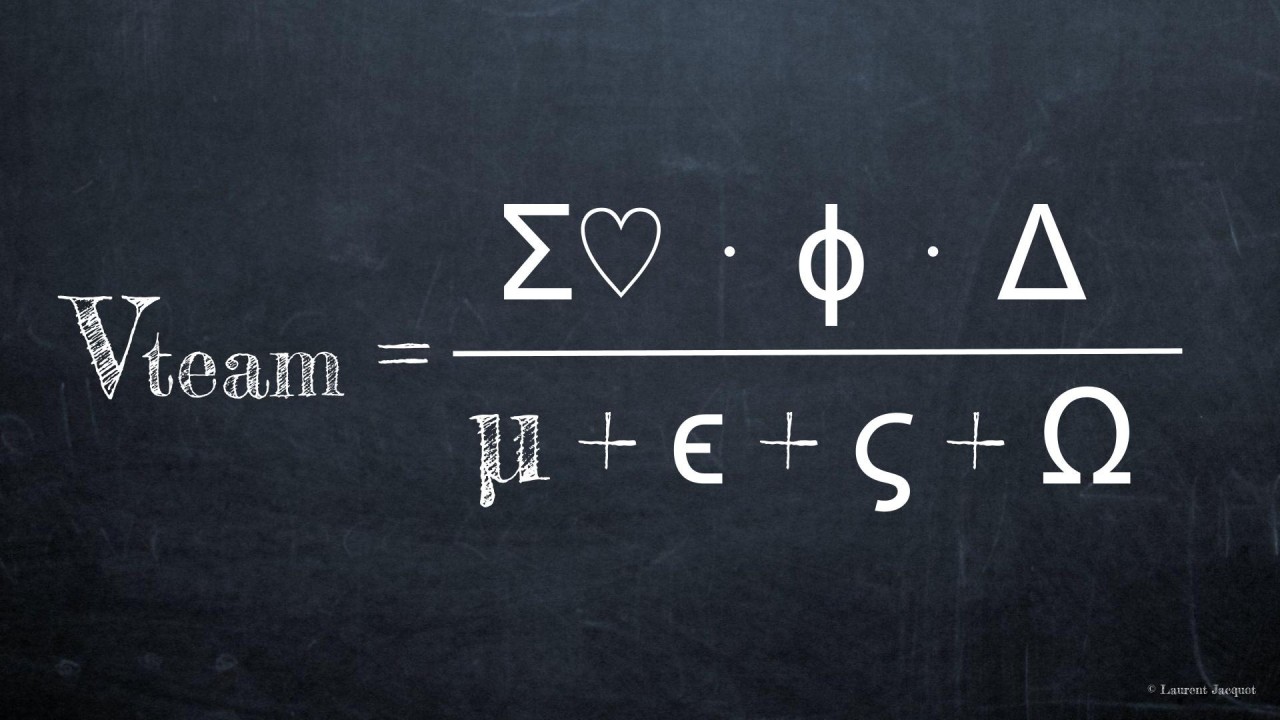
That’s when a formula emerged — not to oversimplify leadership, but to clarify it:
Team velocity equals collective trust, clarity, and autonomy multiplied together, divided by the sum of cognitive load, perfectionism, ego friction, and burnout.
I call it . A personal, human-centric equation capturing what truly moves a team forward — not just fast, but with lasting purpose.
What Fuels Velocity — The Numerators
The numerators represent the forces that, when cultivated, multiply a team’s ability to create meaningful work. These aren’t soft skills or nice-to-haves — they’re the fundamental energies that transform individual effort into collective intelligence.
Uppercase Sigma heart — Collective Trust
Uppercase Sigma heart represents something that cannot be mandated but must be cultivated — the collective trust that transforms a group of individuals into a unified intelligence. This isn’t trust as a soft skill, but trust as the fundamental substrate upon which all meaningful collaboration grows.
When trust is strong, something remarkable happens: people begin to care beyond their immediate scope. In frontend teams I’ve led, I’ve watched developers give thoughtful code reviews not because they’re required to, but because they understand their feedback shapes something larger than any individual contribution. They advocate for accessibility not because it’s a checkbox, but because they envision the humans who will encounter their work.
Trust doesn’t just reduce friction — it deepens commitment. It creates the psychological safety where the best ideas can surface, where mistakes become learning opportunities, where challenges are met with collective intelligence rather than individual defensiveness.
Leaders don’t create collective trust directly — they cultivate the environment where it naturally grows.
Φ — Clarity
φ (Phi) represents clarity — not just in goals and roles, but in the deeper architecture of purpose that keeps effort aligned. Clarity is what prevents even the most motivated teams from pulling in different directions, what transforms individual excellence into coherent progress.
This goes beyond clear communication or well-defined requirements. It’s the kind of clarity that allows everyone to see the same mountain peak, even when they take different paths to reach it. It’s understanding not just what we’re building, but why it matters, how it fits into a larger vision, what success actually looks like.
Without clarity, energy dissipates. With it, individual contributions compound into something greater than their sum. The most effective teams I’ve led share this characteristic: every member can articulate not just their immediate tasks, but how those tasks serve the broader purpose.
The leader’s role here is to remove ambiguity, provide context, and repeat the vision until it echoes within the team.
Δ — Autonomy
Δ (Delta) captures autonomy — the freedom to make decisions, propose solutions, and take ownership within the context of shared purpose. This isn’t independence for its own sake, but the kind of empowerment that unleashes intrinsic motivation and allows people to contribute their full intelligence to shared challenges.
When teams are empowered to shape not just the how but sometimes even the what, they move with a different quality of engagement. Autonomy fuels the pride that comes from true ownership, the satisfaction of applying one’s full capability to meaningful problems.
This sense of ownership flourishes when paired with collective trust and clarity , creating a balanced environment where people feel both supported and empowered. It’s the difference between executing someone else’s vision and contributing to a shared creation.
Great leaders empower others by stepping back without disconnecting. They create space, not distance.
What Slows Velocity — The Denominators
The denominators represent drag — the forces that sap energy, muddle direction, or quietly erode the human foundation upon which all progress depends. These forces often hide beneath the surface of daily operations, undetected by traditional metrics but deeply felt by the people who carry them.
μ — Cognitive Load & Micromanagement
In physics, μ (Mu) represents the coefficient of friction — the resistance that slows motion. In teams, it embodies cognitive load, micromanagement, and the silent drag of unnecessary complexity that accumulates in systems and processes.
Every unclear workflow, every redundant decision point, every subtle overstep increases μ. It may not be visible in sprint reports, but it accumulates — wearing people down before they even begin to create. The developer who spends more time navigating bureaucracy than solving problems, the designer whose creative energy gets absorbed by endless approval cycles, the team that burns cognitive resources on process overhead rather than meaningful work.
Architecture, processes, and leadership should lift mental burden, not add to it.
ϵ — Perfectionism & Fear of Mistakes
In mathematics, ε (Epsilon) represents an infinitesimally small value — the unreachable ideal, always just beyond grasp. In teams, ε manifests as the anxiety that every decision must be flawless, every line of code perfect, every design complete before anyone can see it.
This perfectionism breeds hesitation. The fear that mistakes will derail progress or damage reputation keeps teams from taking necessary risks, from experimenting with better approaches, from the kind of learning that comes only through iteration and refinement.
ε creates a paradox: the pursuit of perfection often prevents the very progress that leads to excellence. It transforms the creative challenge of building something meaningful into the impossible task of building something perfect.
Mistakes are part of progress, not barriers to innovation.
ς — Ego & Unseen Friction
In Greek, ς (Final Sigma) is the silent sigma — used only at the end of words. It embodies the hidden ego dynamics that create subtle tension, unspoken resentment, and quiet defensiveness within teams.
Ego, at the individual level, drives ambition and craftsmanship. It motivates people to care deeply, to strive for excellence, to take pride in their work. But when left unbalanced in a collaborative environment, it can quietly distort alignment. Ideas become territories to defend rather than contributions to improve. Questions feel like threats rather than opportunities for collective intelligence.
The most insidious aspect of ς is its invisibility. Unlike obvious conflicts, ego-driven friction operates beneath the surface, slowly eroding the trust and clarity that make everything else possible.
Healthy cultures surface tension early, address ego with empathy, and protect momentum through humility.
Ω — Burnout & Emotional Decay
Ω (Omega), the final letter of the Greek alphabet, symbolizes the end — the point where energy, curiosity, and care begin to fade. In teams, Ω represents what happens when purpose erodes, when the human foundation of all work starts to crumble.
This isn’t always dramatic burnout — sometimes it’s the quiet withdrawal of discretionary effort, the gradual decline of the extra consideration that transforms good work into excellent work. People still deliver, but without the spark that creates innovation, without the care that ensures quality, without the engagement that sustains long-term performance.
Even high-performing teams are vulnerable to Omega. It creeps in when growth stalls, when praise is rare, when people feel unseen, unheard, or overextended.
Sustainable cultures are built like relay teams — systems that carry both the product and the people forward. Not with perks or pressure, but through purpose, continuity, and the trust that someone else will one day take the baton.
Finding the Balance: Numerators vs. Denominators
This formula reveals a fundamental truth about team dynamics: velocity isn’t just about acceleration — it’s about the relationship between forces that propel and forces that resist. The numerators — Collective Trust, Clarity, and Autonomy — create the conditions for speed and quality work. Without these, progress becomes a loop, not a path. Teams drift, and innovation turns into maintenance.
But the denominators matter equally. Cognitive load, perfectionism, ego friction, and burnout act as invisible weights that can slow even the most motivated teams. These forces may not always be obvious in the day-to-day, but over time they accumulate, creating resistance that reduces both speed and effectiveness.
Effective leadership is about maintaining this balance. It’s about recognizing the forces at play, nurturing what drives teams forward, and addressing what holds them back.
When the balance holds, velocity becomes something deeper than momentum — it becomes meaning in motion.
Sustaining Velocity Over Time
Understanding velocity as a relationship between these forces changes how we think about sustainable performance. It’s not about optimizing individual components in isolation — it’s about creating and maintaining the dynamic equilibrium that allows teams to perform at their best over extended periods.
This requires continuous attention to the health of relationships, the clarity of purpose, and the sustainability of pace. It means recognizing that the same forces that create initial momentum must be renewed and refreshed as teams evolve, as challenges change, as people grow in their roles and capabilities.
The most effective leaders I’ve worked with understand this implicitly. They don’t just manage tasks or optimize processes — they cultivate the invisible architecture of team dynamics, the human foundation upon which all technical achievement depends.
Velocity isn’t a sprint — it’s a marathon, where culture paves the track and fuels the run.
A Formula, Not a Template
This equation emerged from necessity — shaped by organizational gaps, challenges in alignment, and a personal vision for cultures that drive engagement and progress. It reflects patterns I’ve observed across continents and industries, but patterns that needed a vocabulary, a way to make the invisible visible.
Leadership isn’t one-size-fits-all. Culture is a living system, shaped collectively. I’ve adapted this formula over time — managing up, navigating dysfunctions, aligning with visionaries, and resisting autocratic drifts. I’ve used it to bring alignment where there was noise, to restore direction where there was uncertainty, and to inspire where there was fatigue.
But no formula works in isolation. Through distributed teams, I’ve seen how trust takes different shapes around the world — sometimes more relational, sometimes more transactional — and how autonomy lands differently depending on culture, seniority, or past experience. Clarity can’t always be forced from the top; sometimes it grows from the ground up. Culture isn’t static. It’s contextual, shaped by vision, shared values, and the invisible weight of history. What works in one place may fall flat in another.
This approach is not rigid. It flexes with culture, personalities, and constraints. What matters is not the math, but the mindset behind it: leading with integrity, adapting with empathy, and always striving for a balance that makes velocity sustainable — and human.
A formula can guide, but never replace the judgment and empathy leadership requires.
Conclusion
Velocity, at its core, is not just a metric — it’s a mirror. It reflects how we lead, how we build, and how we care. Behind every outcome is a culture, a context, and a choice.
This formula doesn’t offer guarantees. It offers a mindset — a way to make sense of the moving parts and lead with intention. Because when we get the forces right, we don’t just move fast.
We move well.